Framedlight blog, contemporary, documentary and travel photography with Sue McGilveray
Happisburgh - trapped on the groynes
Get link
Facebook
X
Pinterest
Email
Other Apps
While we were walking down the sea defences in Happisburgh I noticed that a lot of bits and pieces had become attached to the groynes and thought they might make an interesting series of photographs.
We woke to a drizzle the day after our 'Tom Crean experience'. We had not enlisted for the Tom Crean 19 mile endurance walk, and luckily that was sold out anyway, and given the weather would not have been pleasant by any yardstick. Instead we did what any old codger would do under the circumstances and go for a drive. The Slea Head Drive to be more precise and part of what the Dingle tourist board call the 'Wild Atlantic Way'. Wet and wild that particular Saturday. It is manners to drive clockwise around this circular route as the road is very narrow and cars coming the other way, as a couple did, cause all the traffic to snarl up. We started in Dingle where we stopped briefly by the harbour, before continuing until we shortly came to a museum. It was a private, commercial sort of venture, run by an American and called the Celtic and Prehistory Museum. And it was actually very interesting, containing some animal skeletons and stone axes and other such artefacts. Th...
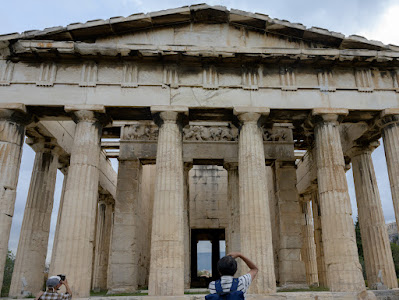
After our trip to the seaside we thought we should examine more of the ancient sites of Athens. So we walked to the district of Monasteriki, the very busy touristic area, where behind iron railings lies the Greek Agora. This occupies a large area and was originally a place where the Athenians senate met, as well as holding the market, places for socialising, temples and craftsmen's workshops. We started by walking up the hill to the Temple of Hephaestus which overlooks the Agora. This temple was completed around 430BC and as Hephaestus was the patron god of metal work and craftsmanship it was built on a very fitting site, although it was used as church from the 7th century AD to 1833. We passed workmen tidying as we walked. From the top we got very good views over Athens. Directly under the temple lies the site of the ancient Bouleuterion which was the senate house where political discussion took place and the Metroon where the state archives were kept. The boule was a sort of pa...
We were due to go on holiday in France for the last 2 weeks in September and I had already booked the Tunnel, going out on the Saturday evening and returning on the Sunday a fortnight later. We have to take the train as the dog in her elderliness has taken objection to being left in the van during the cross channel ferry ride and shows it in a rather organic way. Anyhow Alan discovered that a favourite musician Oren Ambarchi was to play in Bexhill on the Sunday as part of a day of rather weird electronic music put on by Cafe Otto, a club in north London. So I re-booked the train for Sunday night. Oren was due to go on at 12.00 noon and play all afternoon or until he got fed up, so it was a case of turning up and listening for a bit and then moving on. There were other musical events occurring in the Bexhill De La Warr Pavillion - a man who had made a lot of musical toys which all played together rather randomly, a saxophonist and a man and woman who did odd things with a drum and orga...
Not far from the university campus sits the Bahá'í House of Worship. At night this large domed marble edifice glowed like a skinned onion against the sky. The Bahá'í faith is an independent world religion that believes in a unified deity encompassing all other faiths. It has 5 million followers and was founded in Persia in the mid 19th century. There are 8 temples around the world and this one is it's North American base. If you are interested this is their website http://www.bahai.org/beliefs/ . The temple itself was built in 1953 and designed by Louis Bourgeois who spent 8 years on the design. It has a steel superstructure with concrete panels incorporating quartz crystal and white cement to create the lacy filigree which forms the exterior. The internal space is a single entity and is very awe inspiring. You are not supposed to take pictures inside, which I respected. The gardens are very beautiful too but not at their best on a February night. ...




Comments
Post a Comment